

(PDF) JNCIS-ENT JN0-650 Exam and Certification Test Engine
Use JN0-650 Exam Dumps (2026 PDF Dumps) To Have Reliable JN0-650 Test Engine
NEW QUESTION # 21
You have multiple BGP routes to the same prefix with equal local-preference values and AS-path lengths.
In this scenario, which route will be preferred in the route selection process?
- A. The route with the most preferred origin value.
- B. The route with the least preferred origin value.
- C. The route with the lowest MED value.
- D. The route with the highest MED value.
Answer: A
NEW QUESTION # 22
Click the Exhibit button.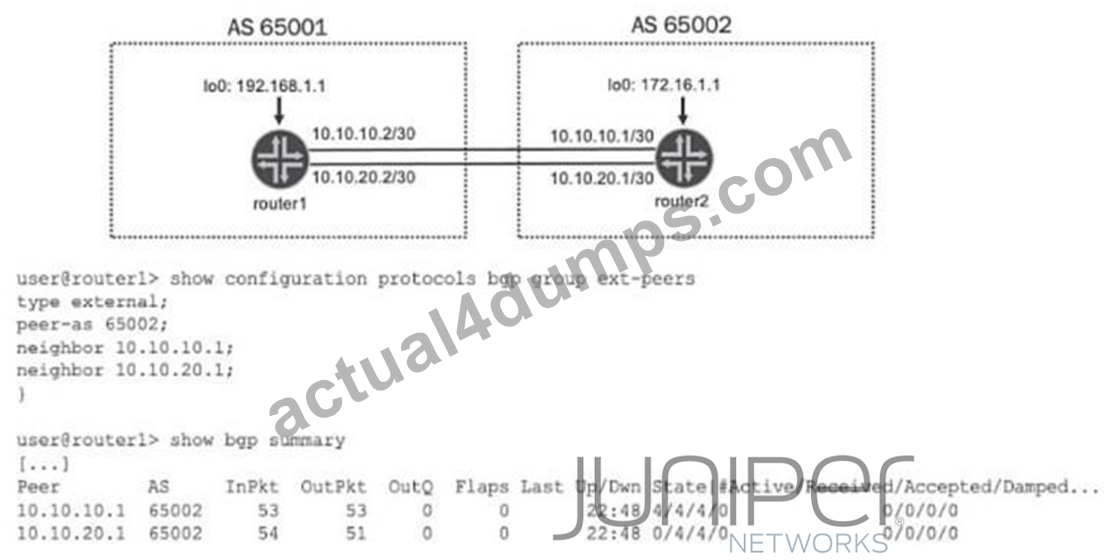
Referring to the exhibit, what will enable active routes from both peers?
- A. Configure neighbor 172.16.1.1 under the ext-peers hierarchy.
- B. Configure neighbor 10.10.20.2 multipath under the ext-peers hierarchy.
- C. Configure multipath under the ext-peers hierarchy.
- D. Configure neighbor 172.16.1.1 multipath under the ext-peers hierarchy.
Answer: C
Explanation:
To enable active routes from both EBGP peers, you must configure multipath under the BGP group (ext-peers). This allows the router to install multiple equal-cost paths from different peers into the routing table, enabling load sharing across both links.
NEW QUESTION # 23
Referring to the exhibit, which two statements are correct? (Choose two.)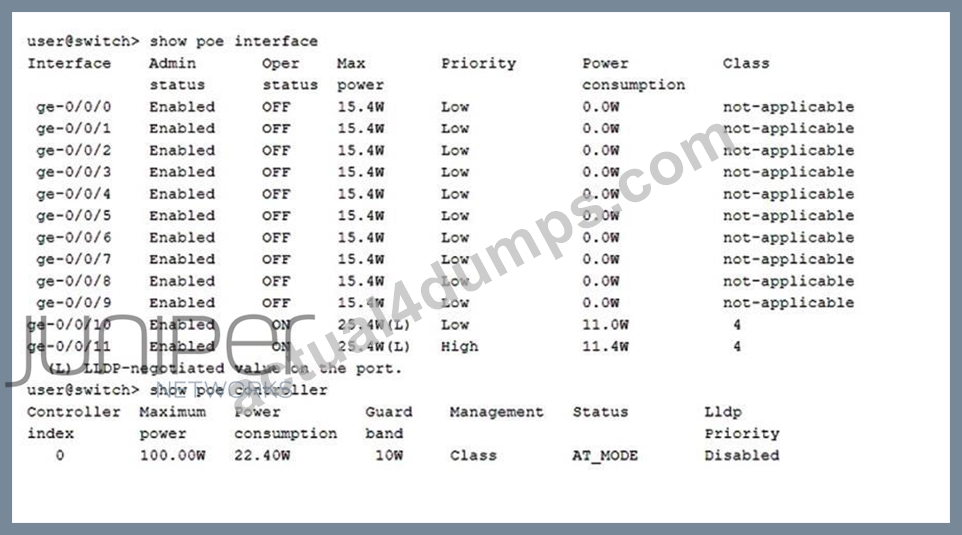
- A. The maximum wattage that this switch can allocate to attached Ethernet devices is 100 watts.
- B. If the total power consumption exceeds 90 watts, the ge-0/0/11 interface will continue to receive power.
- C. PoE is not enabled on the ge-0/0/0 interface.
- D. The ge-0/0/10 interface supports PoE+.
Answer: A,D
Explanation:
POE is enabled in the interface ge-0/0/0 but nothing is connected to it. switch is in AT mode (poe+) and interface ge-0/0/11 supports poe+ judging by maximun wattage.
NEW QUESTION # 24
You notice a mass withdrawal of routes for some of the network hosts. You determine that the link on the ESI interface is down.
Which route type is used in this scenario?
- A. Type 1
- B. Type 5
- C. Type 3
- D. Type 2
Answer: A
NEW QUESTION # 25
What does the 'inet6' NLRI family signify in BGP configurations on Junos devices?
- A. It signifies a special form of BGP community for IPv6.
- B. It signifies the use of a 6-byte AS number.
- C. It signifies the use of BGP over an IPv6 transport.
- D. It signifies the inclusion of IPv6-related information in BGP updates.
Answer: D
NEW QUESTION # 26
Which statement accurately describes the 'next-hop resolution' in BGP?
- A. It refers to changing the next-hop attribute to the local router's address.
- B. It involves selecting the next-hop with the highest IP address.
- C. It includes recalculating the best path when the next-hop changes.
- D. It is the process of determining the validity of the next-hop attribute.
Answer: D
NEW QUESTION # 27
What does the mac-radius restrict configuration command do?
- A. It prevents an end host from using MAC RADIUS for authentication.
- B. It prevents a port from using MAC RADIUS for authentication.
- C. It forces a port to use 802.1x authentication on a port.
- D. It drops 802.1X (EAPOL) frames so that only MAC RADIUS authentication is used on the port.
Answer: D
NEW QUESTION # 28
You are implementing an EVPN-VXLAN edge-routed bridging design using Layer 3 gateway operations. In this scenario, which statement is correct?
- A. Only core switches have IRB interfaces; all Layer 3 routing happens in the core.
- B. Each distribution switch has unique IP addresses for IRB interfaces; routing protocols run on IRB interfaces
- C. Distribution switches share the same anycast IP addresses for IRB interfaces; routing occurs at the distribution layer.
- D. IRB interfaces are disabled; all routing happens through external routers only.
Answer: C
Explanation:
In anEVPN-VXLAN Edge-Routed Bridging (ERB)architecture, also known as a collapsed fabric, the Layer
3 default gateway functionality is moved from the core/spine layer down to the edge (the leaf or distribution layer).
* Anycast Gateways:To support seamless host mobility and redundancy, multiple distribution/leaf switches are configured with thesame anycast IP addressandMAC addresson their IRB interfaces for a given VLAN. This allows a host to move between different switches without needing to update its default gateway configuration or ARP cache.
* Distributed Routing:Routing occurs locally at the edge (distribution layer). Traffic destined for a different subnet is routed by the first switch it hits (the ingress leaf), rather than being backhauled to a central core router.
* Symmetric vs. Asymmetric IRB:Junos OS 24.4 supports both models, but the ERB design typically utilizes symmetric routing for better scalability, where each leaf only needs to know the routes for its locally connected VNIs and uses a transit VNI for inter-subnet communication.
Option Ais incorrect because while unique IPscanbe used (Method 1 in some docs), the defining characteristic of an efficient ERB design is the use of shared Anycast IPs for the gateway.Option Cdescribes a Centrally-Routed Bridging (CRB) design, not ERB.
NEW QUESTION # 29
What causes IBGP route flapping in enterprise networks?
- A. excessive BGP community tagging
- B. packet misordering due to out-of-band management
- C. recursive routing failure in the underlying IGP
- D. misconfigured BGP update intervals
Answer: C
Explanation:
In enterprise networks utilizing Junos OS, IBGP (Internal BGP) route flapping is frequently caused by recursive routing failures within the underlying IGP (Interior Gateway Protocol) , such as OSPF or IS-IS.
* Recursive Next-Hop Resolution: Unlike EBGP, where the neighbor is typically directly connected, IBGP neighbors are often several hops away. Consequently, an IBGP route ' s protocol next-hop is usually a loopback IP address that requires a recursive lookup to resolve. The router must consult its unicast routing table (typically inet.0 or inet.3) to find a physical path to that next-hop.
* The Flapping Mechanism: A " flap " occurs when a route is repeatedly withdrawn and readvertised. If the IGP path used to resolve the BGP next-hop becomes unstable or if the BGP route itself is inadvertently used to resolve its own next-hop (a recursive loop), the BGP next-hop becomes unreachable.
* Impact on Routing Table: When the next-hop cannot be resolved, the BGP route is considered invalid and is withdrawn from the routing table. Once the route is withdrawn, the original IGP path to the next- hop often becomes valid again, causing the BGP route to be readvertised . This cycle of withdrawal and readvertisement creates the instability known as flapping.
* Why other options are incorrect: Packet misordering (Option A) and community tagging (Option B) may affect performance or policy but do not cause a route to be withdrawn and readvertised in this cyclical manner. While update intervals (Option C) control how quickly changes are sent, they are not the root cause of the reachability failure that triggers the flap itself.
NEW QUESTION # 30
A modified deficit round-robin scheduler is defined by which two variables? (Choose two.)
- A. buffer size
- B. Layer 3 fields
- C. transmit rate
- D. Layer 2 fields
Answer: A,C
Explanation:
A modified deficit round-robin scheduler uses the transmit rate to determine how bandwidth is allocated among queues during scheduling operations.
The scheduler also relies on buffer size to control queue depth and manage congestion handling behavior for queued traffic.
NEW QUESTION # 31
Click the Exhibit button.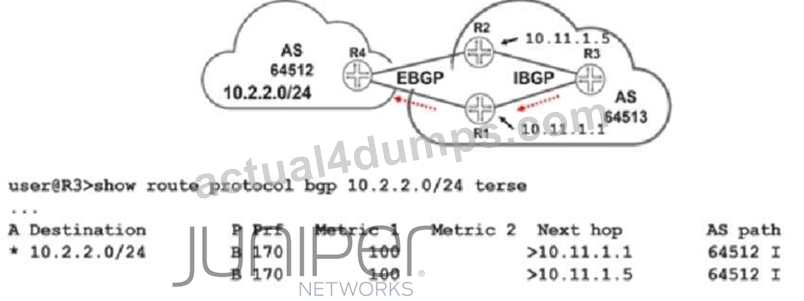
Referring to the exhibit, you want to change the exit point from R1 to R2 to reach 10.2.2.0/24.
Which BGP attribute would you need to manipulate on R3 to achieve this result?
- A. local preference
- B. AS path
- C. origin
- D. MED
Answer: A
Explanation:
Local preference is used within an autonomous system to influence the preferred outbound path to external destinations. Increasing the local preference for routes learned through R2 on R3 causes traffic destined for 10.2.2.0/24 to prefer the exit through R2 instead of R1.
NEW QUESTION # 32
You are implementing the route summarization feature of OSPF.
Which two results do you achieve in this scenario? (Choose two.)
- A. It reduced the routing table size, enabling devices to store and process less information.
- B. It helps in migrating to future multi-area OSPF network designs.
- C. It provides optimal routing in the network.
- D. It reduces the impact of topology changes on a device.
Answer: A,D
NEW QUESTION # 33
You must implement EVPN signaling on an EX Series device that is configured with both underlay and overlay networks. Which network protocol accomplishes this task?
- A. EBGP overlay network
- B. OSPF underlay network
- C. IS-IS underlay network
- D. MPLS overlay network
Answer: A
Explanation:
In an EVPN-VXLAN architecture, the network is divided into two distinct planes: theUnderlayand the Overlay.
* Underlay (IP Fabric):The underlay's only job is to provide IP reachability between the loopback addresses of all VTEPs (Virtual Tunnel Endpoints). This is typically achieved using OSPF, IS-IS, or EBGP.
* Overlay (EVPN Control Plane):The overlay is responsible for carrying Layer 2 MAC and Layer 3 IP reachability information between switches.EVPN signalingis the standard mechanism for this task.
* Protocol Choice (Option D):EVPN usesMP-BGP (Multiprotocol BGP)as its control plane protocol.
On Juniper EX Series and QFX Series switches, the most scalable and recommended design for the overlay isEBGP(External BGP).
* In a 3-stage or 5-stage Clos architecture, EBGP is used in the overlay to exchange EVPN routes (Route Types 1-5) between Leaf and Spine switches.
* EBGP simplifies configuration by avoiding the need for Route Reflectors (required for IBGP) and provides better control over route propagation through BGP community and policy management.
Incorrect Options:
* Options A and Brefer to the underlay protocols. While they provide the path for the VXLAN tunnels, they do not handle the EVPN signaling itself.
* Option C(MPLS) is a different transport technology. While EVPN can run over MPLS (EVPN-MPLS), campus designs on EX series devices specifically use VXLAN as the data plane, making EBGP the standard signaling protocol for the EVPN-VXLAN overlay.
NEW QUESTION # 34
You have deployed 802.1X with server fail fallback enabled on an EX Series switch and specified the vlan-name feature for all access ports. The RADIUS server is unavailable. Which two statements are correct in this scenario? (Choose two.)
- A. All new clients will be granted access only if their requested VLAN matches the configuration.
- B. All clients already authenticated will immediately be disconnected before the re-authentication timer expires.
- C. All clients already authenticated will be unaffected until reauthentication is required.
- D. All new clients will be placed in the referenced VLAN in the configuration and given access.
Answer: C,D
Explanation:
With 802.1X server-fail fallback enabled and vlan-name configured:
Existing clients that are already authenticated continue to have network access until the reauthentication timer expires.
New clients are placed into the configured fallback VLAN and allowed access even though the RADIUS server is unavailable.
NEW QUESTION # 35
You are deploying a EX Series switch to provide PoE support to telephones and security cameras using class mode power management. You want to ensure that the security cameras always have the necessary power to function.
How do you solve this problem?
- A. Set the PoE priority to low on ports that connect to security cameras.
- B. Connect the security cameras to the highest port numbers on the switch.
- C. Configure PoE telemetries.
- D. Set the PoE priority to high on ports that connect to security cameras.
Answer: D
NEW QUESTION # 36
......
JN0-650 Dumps Full Questions with Free PDF Questions to Pass: https://pdfpractice.actual4dumps.com/JN0-650-study-material.html